Designing European Banking Ecosystems
01. Overview
This case study explores how I transformed a regulatory opportunity into a consumer-first fintech. Discover how product strategy, UX design, branding, and development shaped BLO Finance a platform designed to unify fragmented banking experiences across Europe.
02. Concept Overview
Breaking Financial Borders
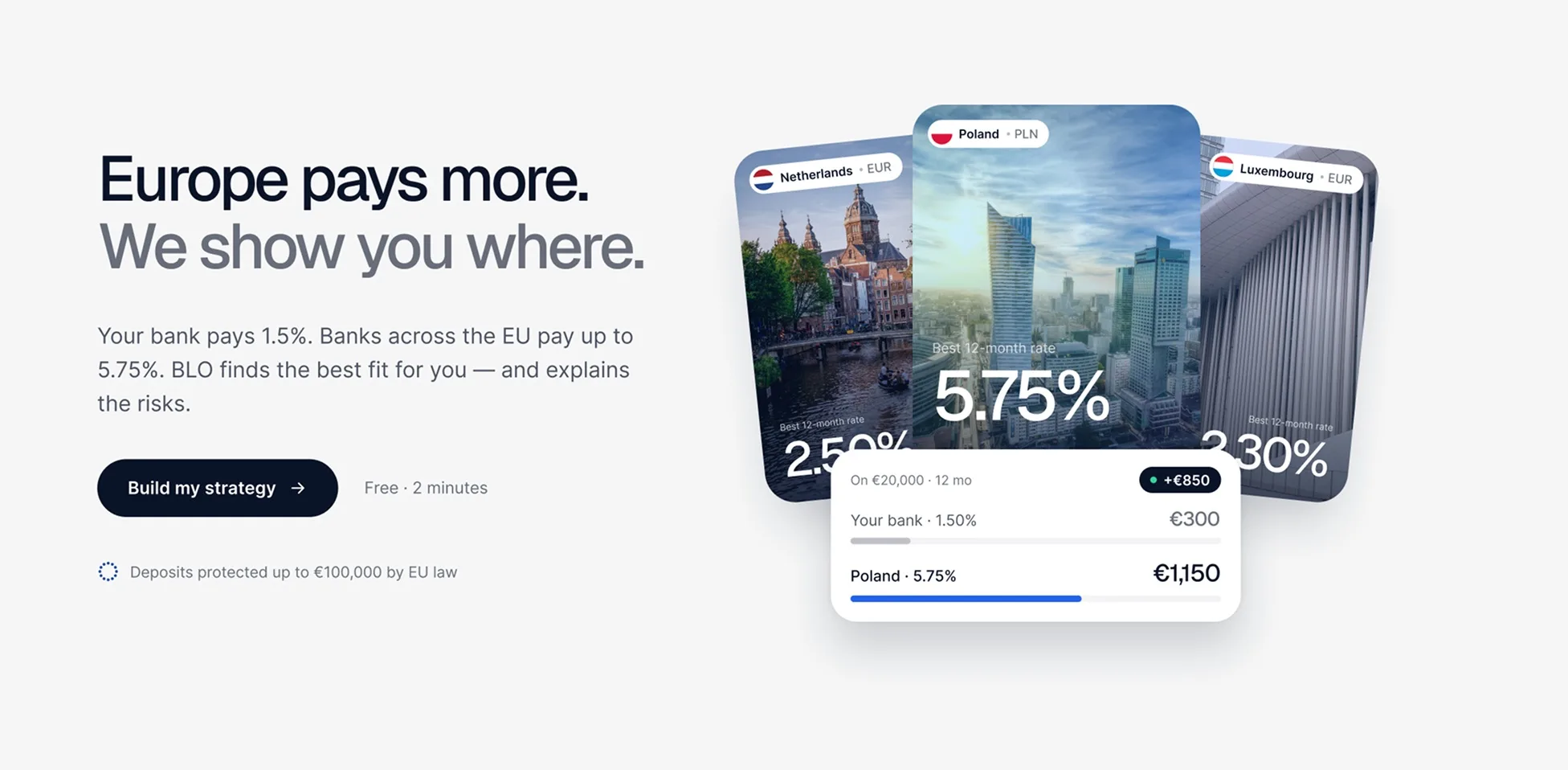
Rather than creating another neobank, we explored how upcoming European regulations could unlock a new layer of financial experiences. The result was BLO Finance—a platform designed to help users discover, compare, and access financial products across Europe through a unified experience.
Outcomes
Validated Financial Fragmentation as a Core Problem: Research revealed that users struggle to discover and access attractive financial products beyond their domestic market.
Identified Emerging Behavioral Patterns: Analysis suggested that complexity, unfamiliar regulations, and language barriers often discourage users from exploring better financial opportunities abroad.
Scalable Product Ecosystem: Established a foundation for multiple interconnected products, including BLO Finance, Strategist, and Aethra, unified through a shared design language.

03. Opportunity Space
Banking Without Borders
Challenge
Despite operating within a single market, Europeans still experience banking through isolated national systems. Accessing better rates, foreign accounts, or financial products across borders remains unnecessarily complex and often inaccessible to the average user.
Solution
BLO reimagines European banking as a single experience. Through product aggregation, personalized recommendations, and future cross-border onboarding capabilities, the platform helps users make better financial decisions regardless of geography.

Breaking Into Finance
As a student entering the financial industry, I faced the challenge of understanding a highly regulated ecosystem where banking infrastructure, compliance requirements, user needs, and business incentives all intersect. Designing a meaningful solution required going far beyond interface design and developing a deeper understanding of how the financial system operates.
Learning Through Building
Rather than treating complexity as a barrier, I used the project as an opportunity to learn through building. Through continuous research, regulatory analysis, conversations with industry professionals, and rapid prototyping, I gradually transformed a knowledge gap into a product vision grounded in both user needs and market realities.
05. UX Design
Trust Over Logic
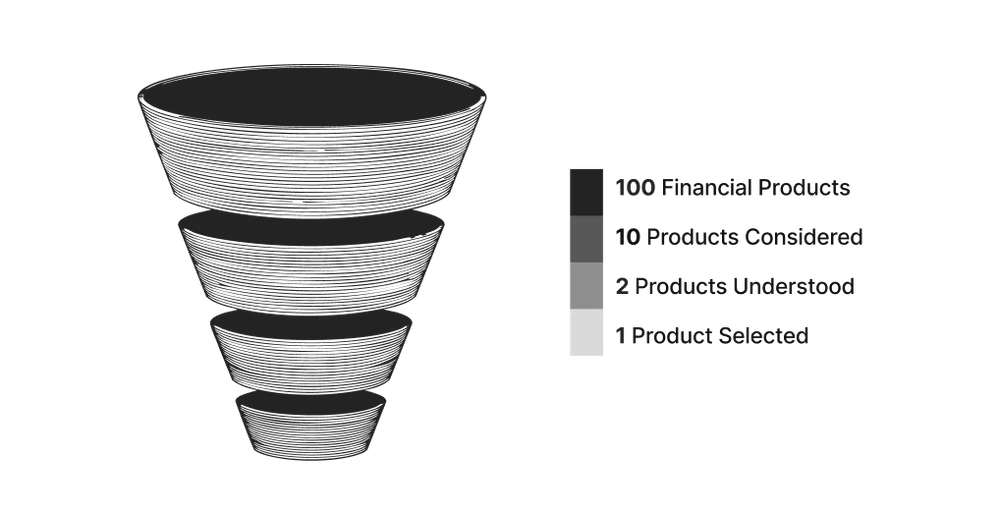
Financial decisions are often driven by familiarity and perceived safety rather than objective product advantages.
Hidden Opportunity Blindness
Users rarely search beyond their domestic banking market, even when better alternatives exist elsewhere.
Trust Drives Financial Decisions
People prefer familiar institutions over potentially better options because trust often outweighs rational optimization.
Decision Fatigue Creates Inaction
Too many financial products lead users to postpone decisions entirely “The Paradox of Choice”–Why More Is Less.
UX Strategy
Leverage Decision
Simplifying Financial Choices: Financial decisions often require users to compare dozens of variables, including interest rates, fees, eligibility requirements, and long-term returns. For many people, this complexity creates uncertainty and discourages action altogether.
I designed BLO to reduce cognitive load through personalized recommendations and structured decision support. Rather than overwhelming users with raw financial data, the experience focuses on surfacing the most relevant opportunities and transforming complex comparisons into clear, actionable guidance.
Unify Experiences
One Financial Journey: European banking is still experienced through disconnected systems, local markets, and institution-specific platforms. Discovering and accessing financial opportunities across borders often requires navigating multiple websites, languages, and onboarding processes. My goal was to create a unified experience layer that sits above traditional financial institutions. By bringing together discovery, comparison, and future account access into one ecosystem, BLO helps transform fragmented financial interactions into a single, understandable journey.
06. UX Design
Product Discovery Platform
Platform centralizes financial opportunities from multiple institutions, making discovery, comparison, and evaluation significantly easier.
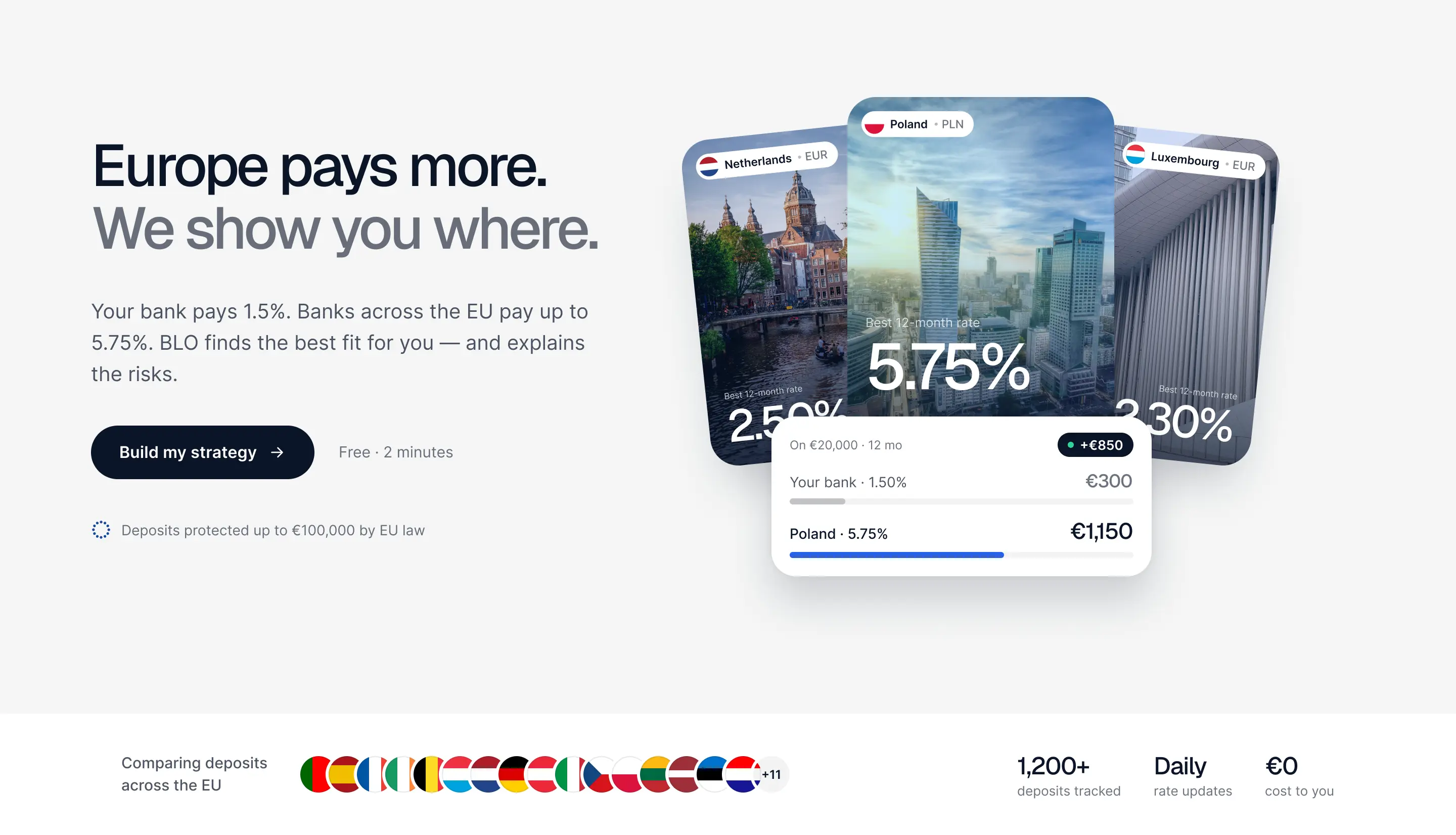
A Continent of Choice: The fanned country cards, real city photography, and calm light background create a sense of range that traditional fintech interfaces often lack. I wanted users to feel that they were choosing from the whole of Europe rather than a single bank.
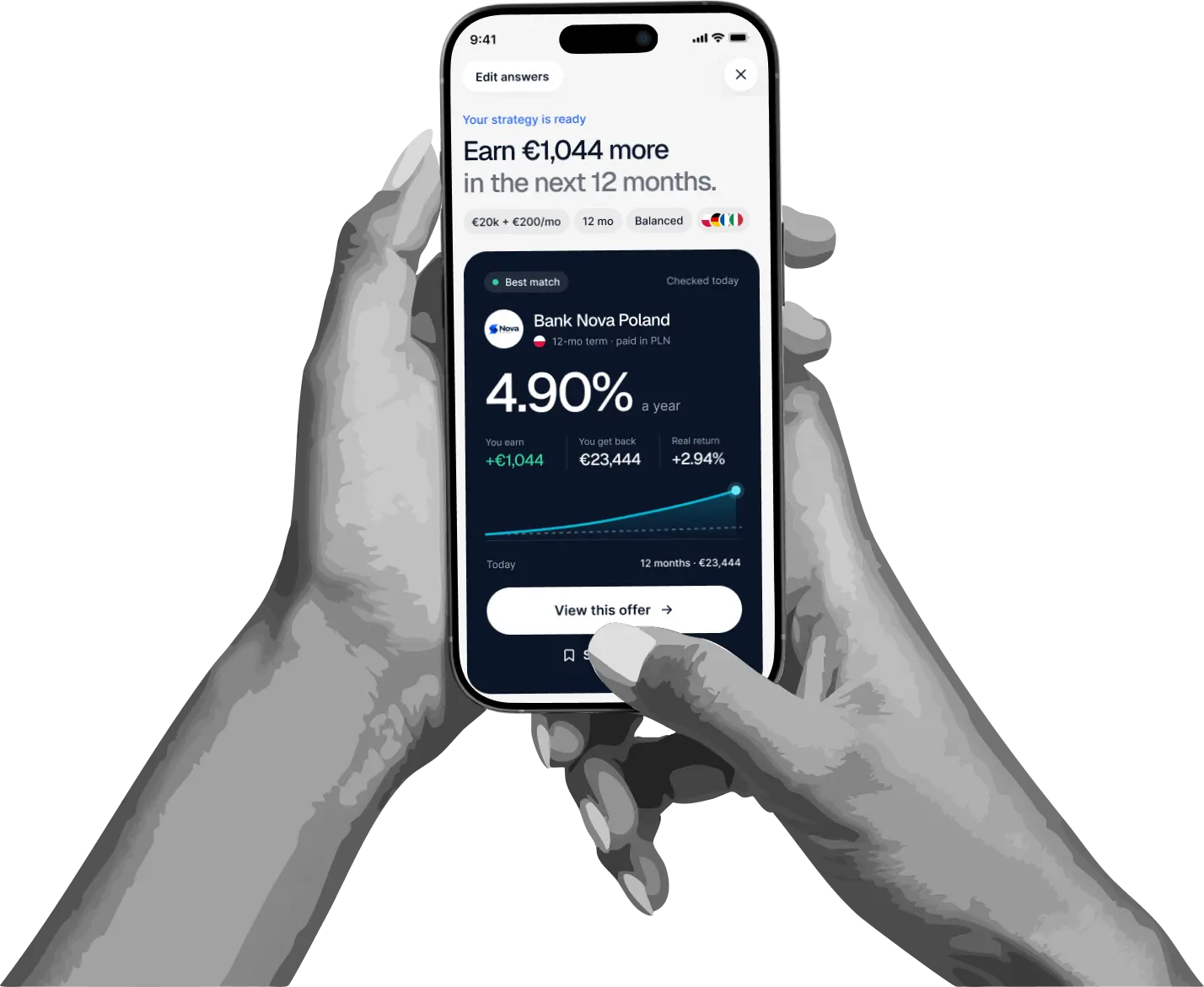
Make Returns Tangible: I designed each country card to show a live rate rather than a static promise. An earnings summary beneath the cards translates that rate into money, transforming an abstract percentage into a clear, personal, and immediately understandable outcome.

Spatial Recognition: People understand places faster than spreadsheets. Pairing each rate with a city, a flag, and a currency makes cross-border products familiar and easier to comprehend.

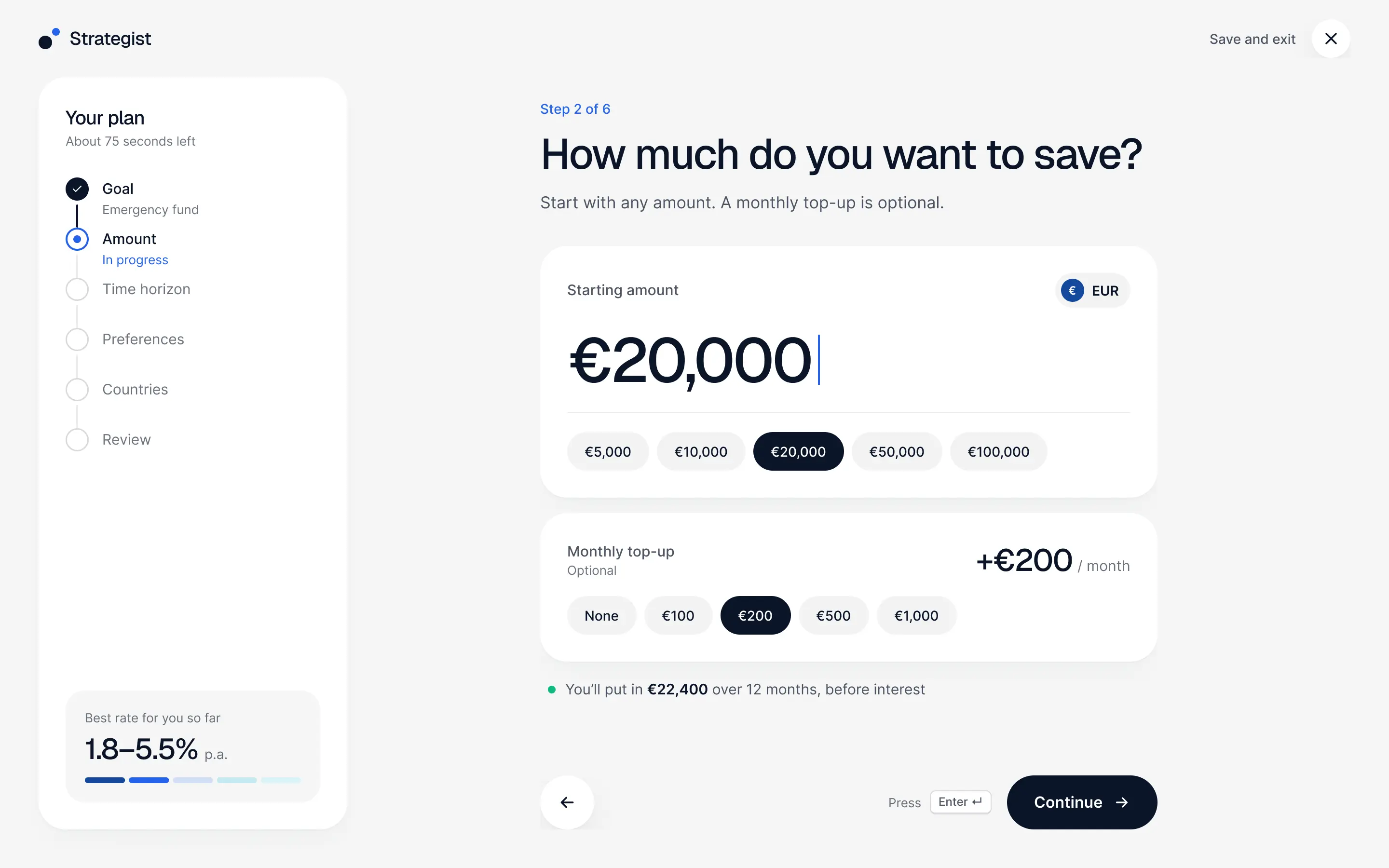
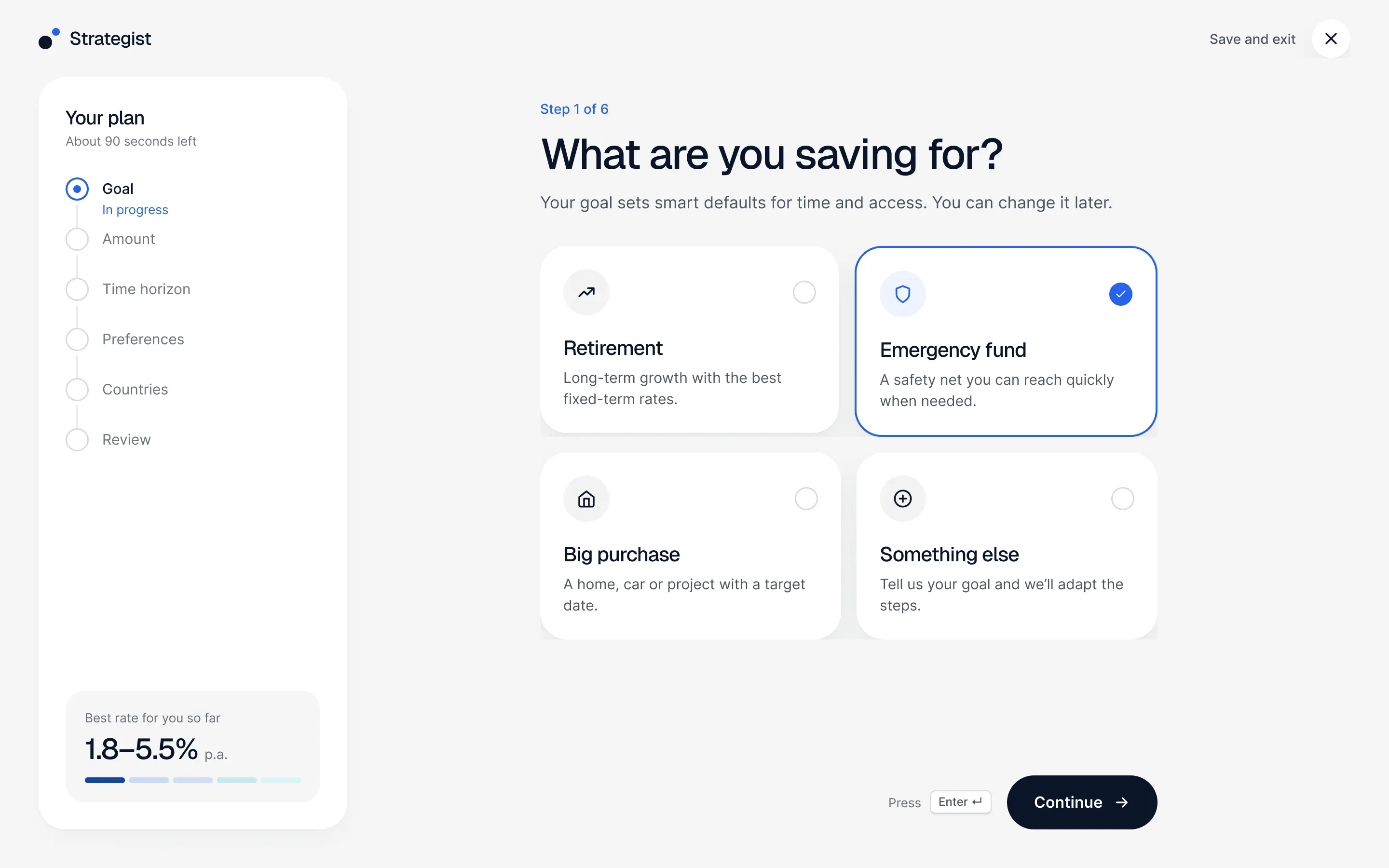
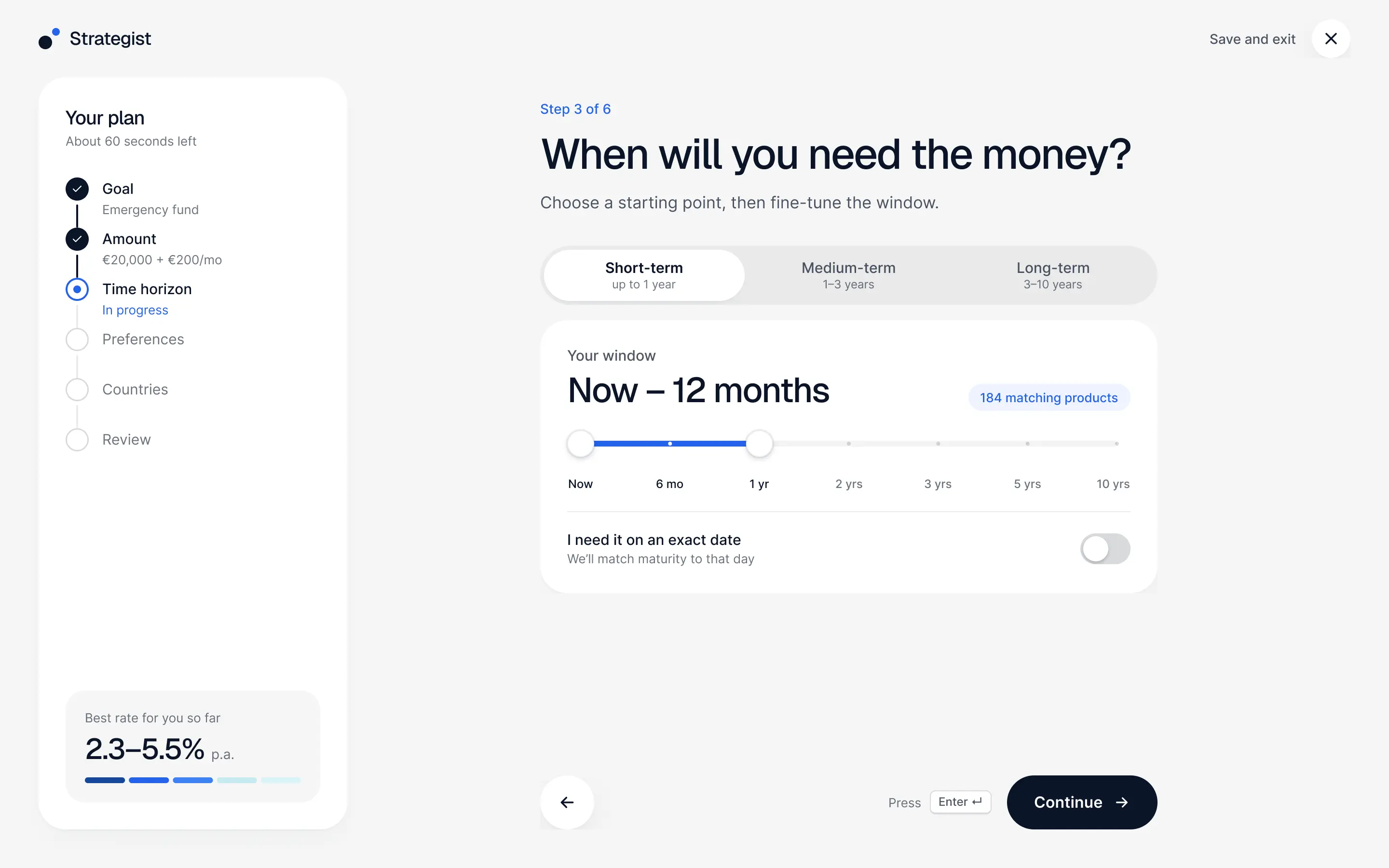
Curiosity Gap: Users are naturally motivated to continue when information is partially revealed. A live rate estimate sharpens with every answer, encouraging users to complete the journey rather than abandon it.
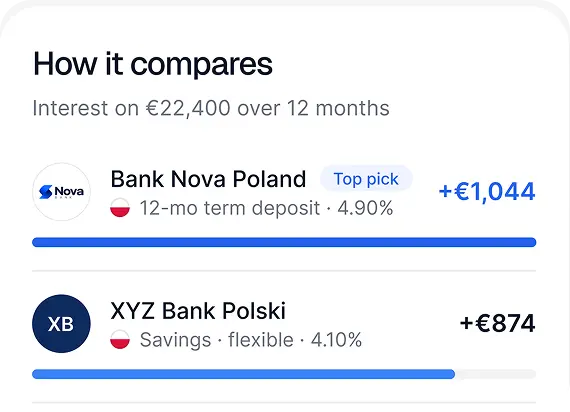
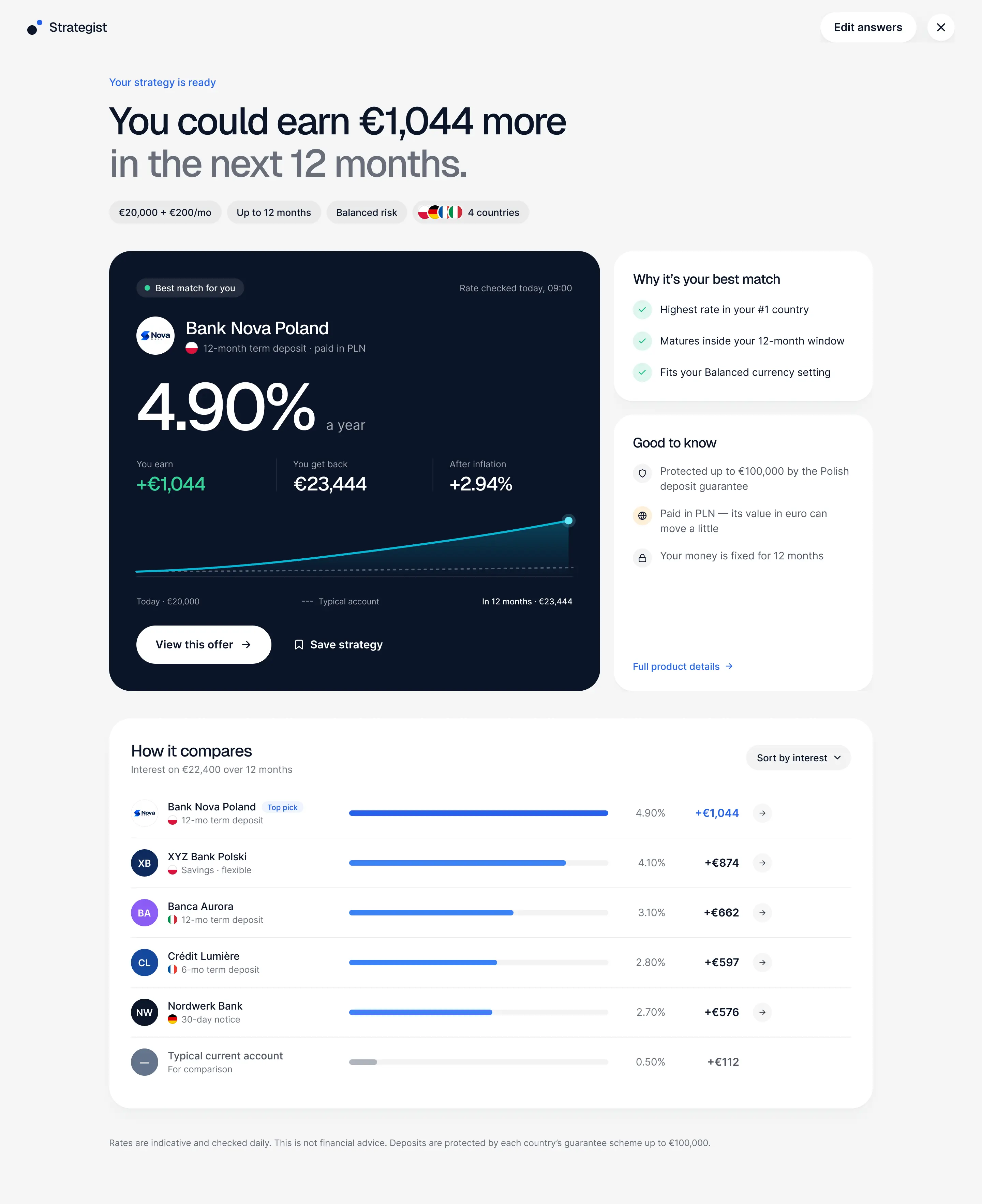
Opportunity Ranking: Options are ordered by the return they deliver, turning complex offers into a scannable comparison. A familiar baseline gives every result a clear point of reference.
CTAs Drive Decisions Forward: A primary and a secondary action let users open the offer immediately or save their strategy for later, supporting different levels of intent.

Mental Model Alignment: People measure savings in money rather than percentages. Leading each result with the amount earned leverages this model, making outcomes easier to understand.

Sequential Colours: Designed for representing a single value progressing from low to high, such as APY heatmaps, intensity scales, or ranked opportunities. Allows magnitude to be communicated primarily through brightness and saturation.

Categorical Colours: Used for distinct categories such as countries, products, or chart series. The colors ensure strong visual separation while maintaining a cohesive brand identity across dark interfaces.

Diverging Colours: Designed for values that move around a meaningful midpoint, such as returns versus break-even, benchmark performance, or gain and loss scenarios. The palette follows the established financial convention of red and green.
Foundation of Strategist
BLO Strategist was designed as a discovery and decision layer sitting above traditional financial institutions. Instead of replacing banks, the platform helps users navigate them.
Discovery
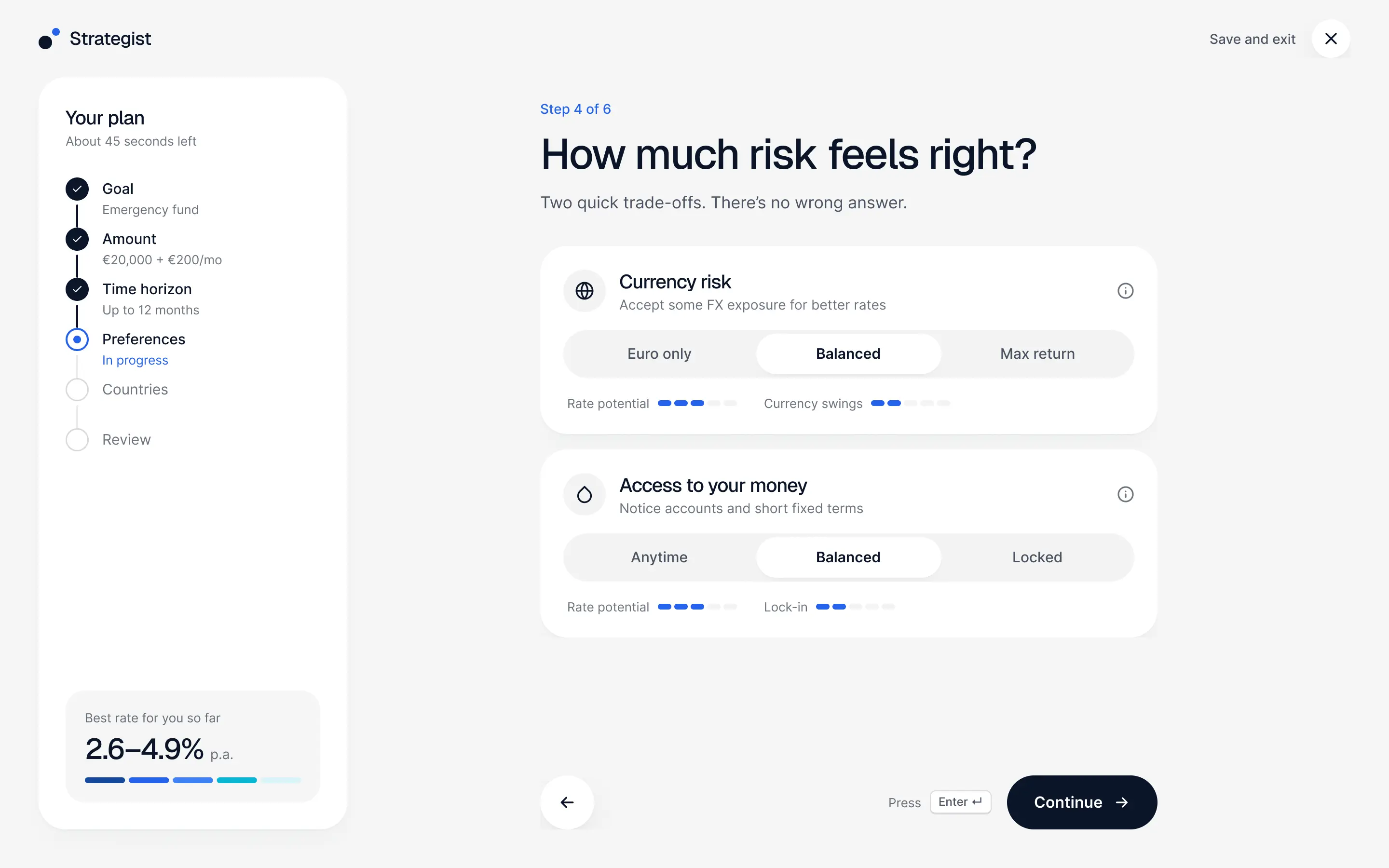
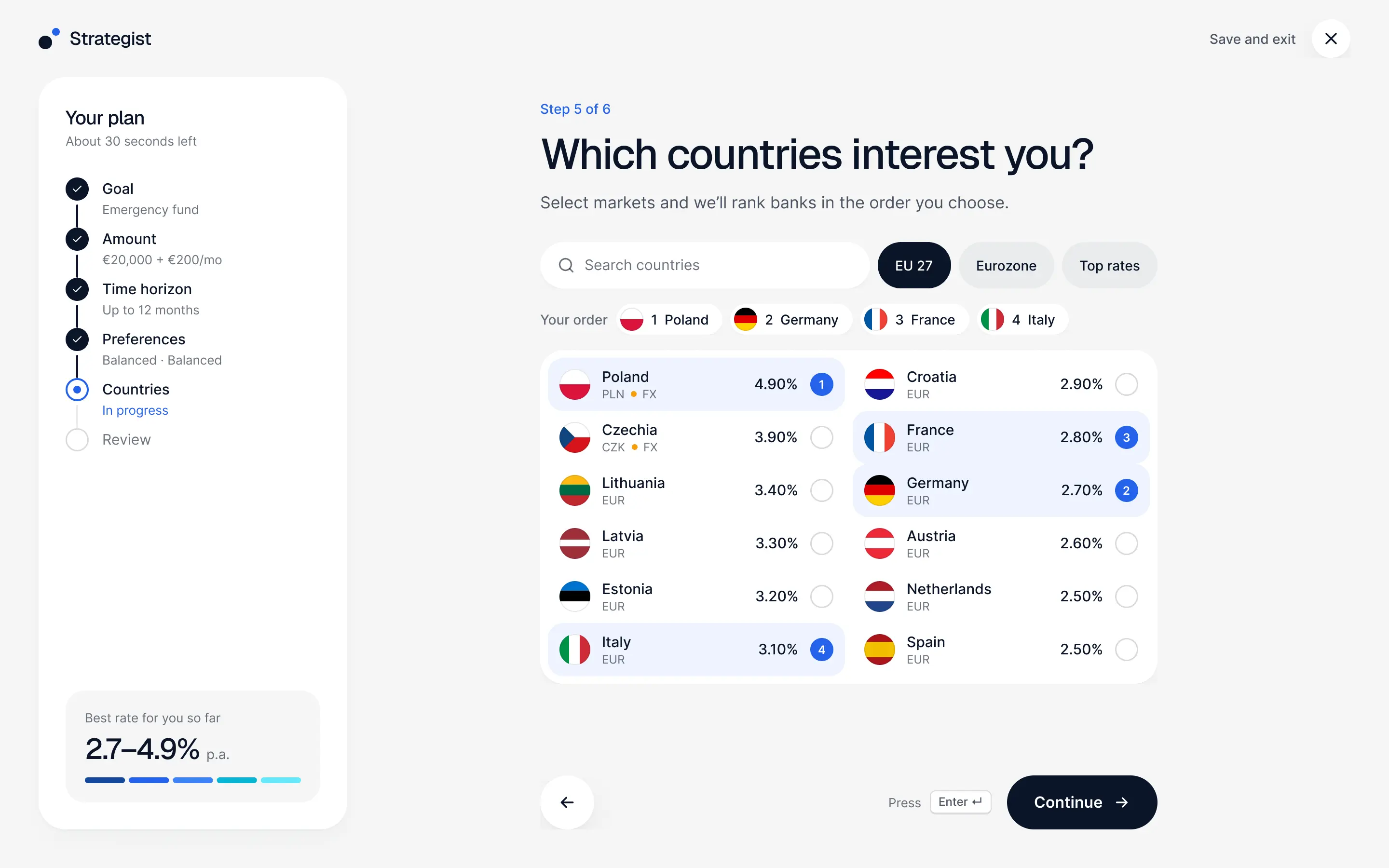
Turning Complexity Into Questions: I designed Strategist to understand users first. The onboarding flow breaks a complex financial decision into a series of focused questions, gradually collecting goals, risk preferences, time horizons, and market access requirements.
Strategy
Once preferences are collected, Strategist translates thousands of data points into personalized recommendations. Rather than overwhelming users with raw market information, the system surfaces the most relevant opportunities and clearly explains why each option was selected.

Design Concept
The Dot Philosophy
The Origin Point: Across mathematics, science, and design, the dot represents a beginning. Every line starts from a point, every shape emerges from a coordinate, and every system can be reduced to its smallest unit. For BLO, the dot symbolizes the starting point of a financial journey—one decision, one opportunity, one connection that can lead to something larger.
Unity Through Simplicity: The circle is often viewed as the most complete geometric form. Unlike squares or triangles, it has no hierarchy, no beginning, and no end. Every point on its boundary is equal.


06. Closing
The Journey Just Begins
Designing What Doesn't Exist Yet: BLO taught me that great financial experiences require more than attractive interfaces. They require understanding regulation, market structure, user psychology, and product strategy simultaneously.
Winning Moments
End-to-End Ownership: Taking an idea from concept to production-grade MVP across strategy, design, branding, and development.
Turning Complexity Into Clarity: Transforming regulations, financial infrastructure, and market fragmentation into a user-centered experience.
Building an Ecosystem: Designing a connected family of products that extends beyond a single application.
Lessons Learned
Learn Through Building: The fastest way to understand a complex industry is to immerse yourself in it and start creating.
Simplicity Creates Trust: In finance, clarity is often more valuable than adding another feature.
Think In Systems: The strongest products are not isolated features—they are ecosystems connecting users, businesses, and technology.